
Is It Safe To Swim In The Daintree River Where Croc Cruises Run?
Why the Daintree River cruise stretches are never swimming water, what Queensland's crocodile rules say, and where day tours do include a swim.
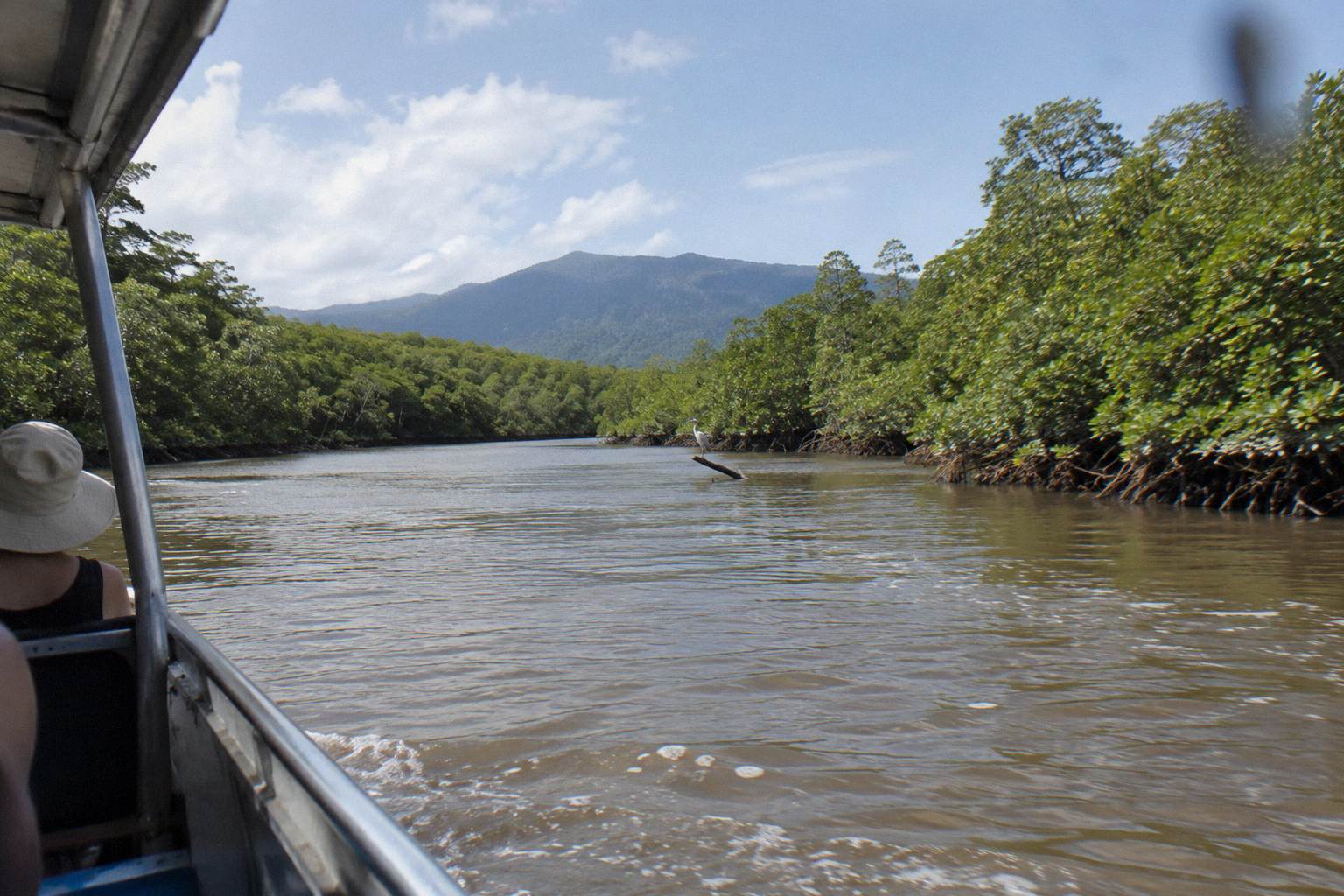
No. The stretches of the Daintree River where crocodile cruises operate are estuarine crocodile habitat, and Queensland's own wildlife advice is that no waterway within their natural range can be considered crocodile free. Every cruise sold on that river is a boat-based spotting trip: nobody swims from the boats, nobody swims at the departure jetties, and the operators themselves frame the experience as wildlife watching from a vessel.
That answer surprises people who arrive expecting something like a rainforest swimming hole. The Daintree River is a wide, tidal, mangrove-lined system, and the animals that live in it are estuarine crocodiles, the same species that grows to over 4 metres in length, with average males at 3 to 4 metres and 200 to 300 kilograms. The Queensland Government notes they are most commonly seen in the tidal reaches of rivers, which is precisely where the cruise boats run. A swimming question and a cruise question turn out to be about two completely different kinds of water.
The cruises themselves exist partly because of that distinction. A boat gives you the river safely: Queensland's boating advice is to keep arms and legs inside the boat and use the boat as a barrier, and the cruise operators build their whole trips around that principle. If the water were swimmable, the boats would be a far harder sell. A reader asking about swimming is really learning, in one step, why the cruise format exists at all.
That said, plenty of Daintree day trips do include a swim, just never in the crocodile river. Mossman Gorge, in the freshwater reaches of Daintree National Park, is the classic stop, and some full-day itineraries add a waterfall swim in the rainforest upstream. Those swims are separate destinations with separate conditions, reached by road, not by boat from the cruise jetties. Neither the gorge nor the waterfall has anything to do with the tidal brown water the boats work, and keeping those two worlds separate is the habit that makes a Daintree day run smoothly.
| Quick fact | The detail |
|---|---|
| Swimming in the Daintree River cruise stretches | Not advised; the Government says no waterway in crocodile range is crocodile free |
| What the cruises involve | Boat-based wildlife spotting from a vessel, 1 to 2 hours depending on the operator |
| Closest swimming to the cruise jetties | Mossman Gorge, a freshwater national park swimming spot reached by road |
| Crocodile species present | Estuarine crocodiles, growing to over 4 metres |
| Legal minimum distance from a basking crocodile | 10 metres; closer can be an offence in Queensland |
| Advice distance from the water's edge | Stay more than 5 metres back |
For trip planning built around the boats rather than the swimming, the crocodile tours departing Port Douglas pull the local options into one place, including the only scheduled croc cruise that leaves Port Douglas itself.
Where The Cruise Boats Actually Run
Every Daintree River cruise covered here departs from the south side of the river or from Daintree Village, and none of them crosses the Daintree Ferry. The village jetty at Stewart Street sits on the upper river, narrower and calmer with overhanging trees, while the Lower Daintree departure points near the ferry are a wide tidal estuary lined with mangroves. Both are crocodile waters.
The geography matters because visitors sometimes assume the ferry crossing divides safe water from dangerous water. It does not. Crocodile Express runs one route from Daintree Village and a second from a kiosk about 300 metres before the ferry crossing on Cape Tribulation Road, and it treats both as the same kind of habitat. Bruce Belcher's uses its own private jetty at 2856 Mossman-Daintree Road, before the ferry, and Daintree River Cruise Centre sits on the south side just before the village, and tells guests not to cross the ferry at all. Solar Whisper's ticket office is about 400 metres before the ferry on the Esplanade at Lower Daintree.
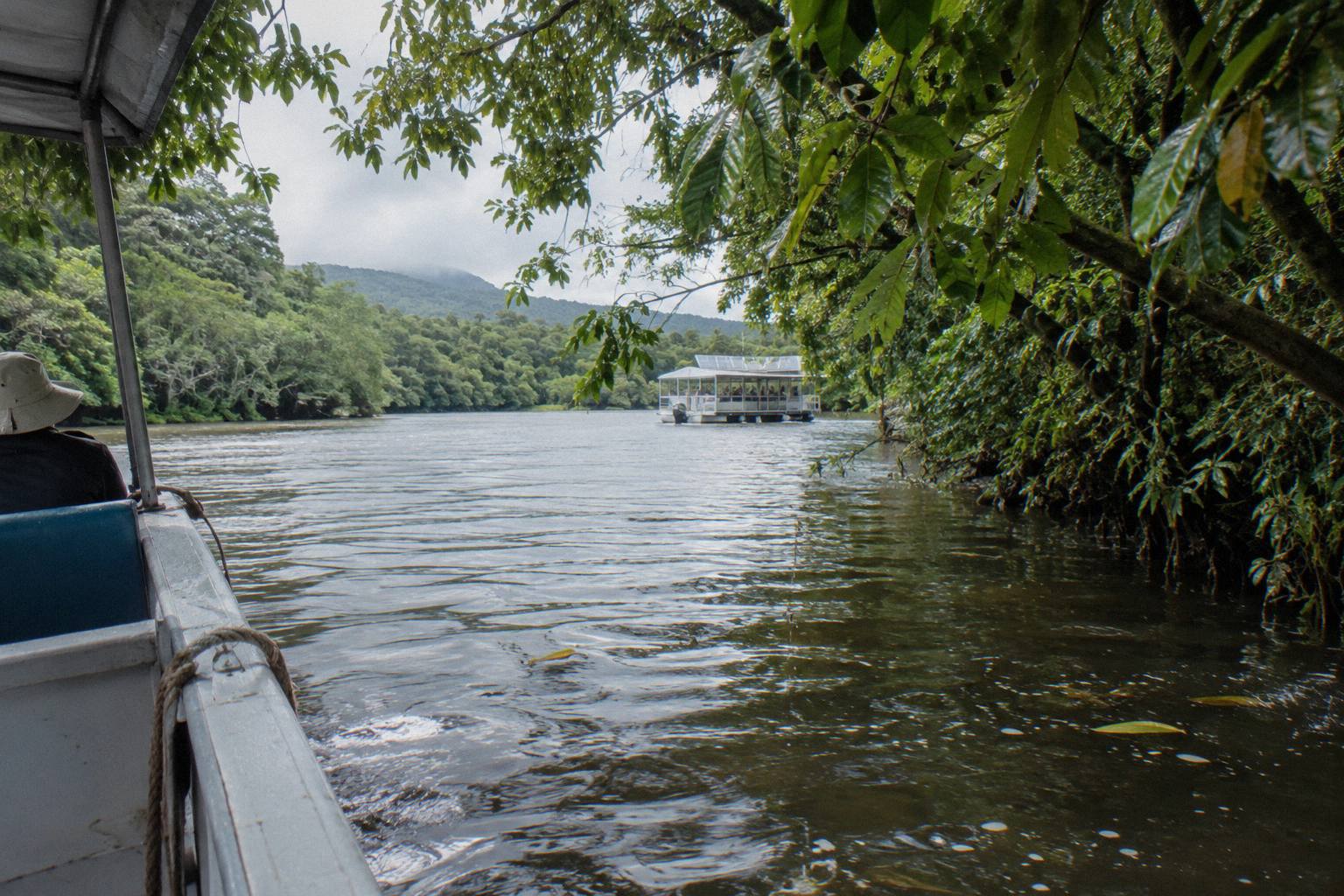
Driving out is simple: Solar Whisper's own guidance puts Daintree Village and Lower Daintree about 45 minutes from Port Douglas, about 30 minutes from Mossman and about 1.5 hours from Cairns. That drive time is also why the swim question comes up so often, because Mossman sits between Port Douglas and the river, and the freshwater gorge there is a natural stop on the same day. More on that pairing later.
| Departure point | Who uses it | The water there |
|---|---|---|
| Stewart Street jetty, Daintree Village | Crocodile Express Cruise 1, Daintree Boatman | Upper river: narrower, calmer, overhanging trees |
| South side before the village, Mossman-Daintree Rd | Daintree River Cruise Centre, Bruce Belcher's | River and private jetty stretches, rainforest banks |
| Cape Tribulation Road near the ferry | Crocodile Express Cruise 2, Solar Whisper | Lower Daintree: wide tidal estuary with mangroves |
For anyone weighing how the village stretch compares with the ferry end, the Daintree Village jetties and ramps guide walks through each boarding point in detail, and the ferry timing question settles whether a crossing belongs in the day at all. Neither departure area has a swimming component, and none of the operators offers one, which is worth stating plainly because the question keeps arriving in trip-planning forums.
The one cruise in the region that does not use the Daintree River at all is the Lady Douglas River Cruise, which departs the Crystalbrook Superyacht Marina at 44 Wharf Street in Port Douglas and spends its 1.5 hours on Dickson Inlet, a mangrove inlet that is a different waterway entirely. It is the only scheduled croc cruise covered here that leaves Port Douglas itself, with a bar beverage and snacks included, and a 4.6 rating from 571 reviews, from US$32 per person. Dickson Inlet is no more swimmable than the Daintree: it is the same species of crocodile in the same kind of tidal mangrove habitat, and the cruise is just as firmly a boat trip.
What Queensland's Crocodile Rules Actually Say
Be Crocwise advice is to stay more than 5 metres from the water's edge and be extra cautious at night, dusk and dawn. The 5 metre line is safety advice. The 10 metre line is law: it is an offence in Queensland to stay within 10 metres of a crocodile basking on a sandbar or riverbank, to disturb one from a boat within 10 metres without reasonable excuse, or to feed one.
Those two numbers do different jobs and people merge them constantly. Five metres is what keeps you alive at a riverbank. Ten metres is the distance at which staying put or approaching becomes a legal matter rather than a judgement call. Neither number describes a swimming condition, and no combination of them adds up to a green light for getting in the water. The official Queensland crocodile pages spell out the species' range, from Gladstone up through Cape York Peninsula and throughout the Gulf of Carpentaria, and the Be Crocwise guidance carries the water-edge and small-craft advice quoted here.
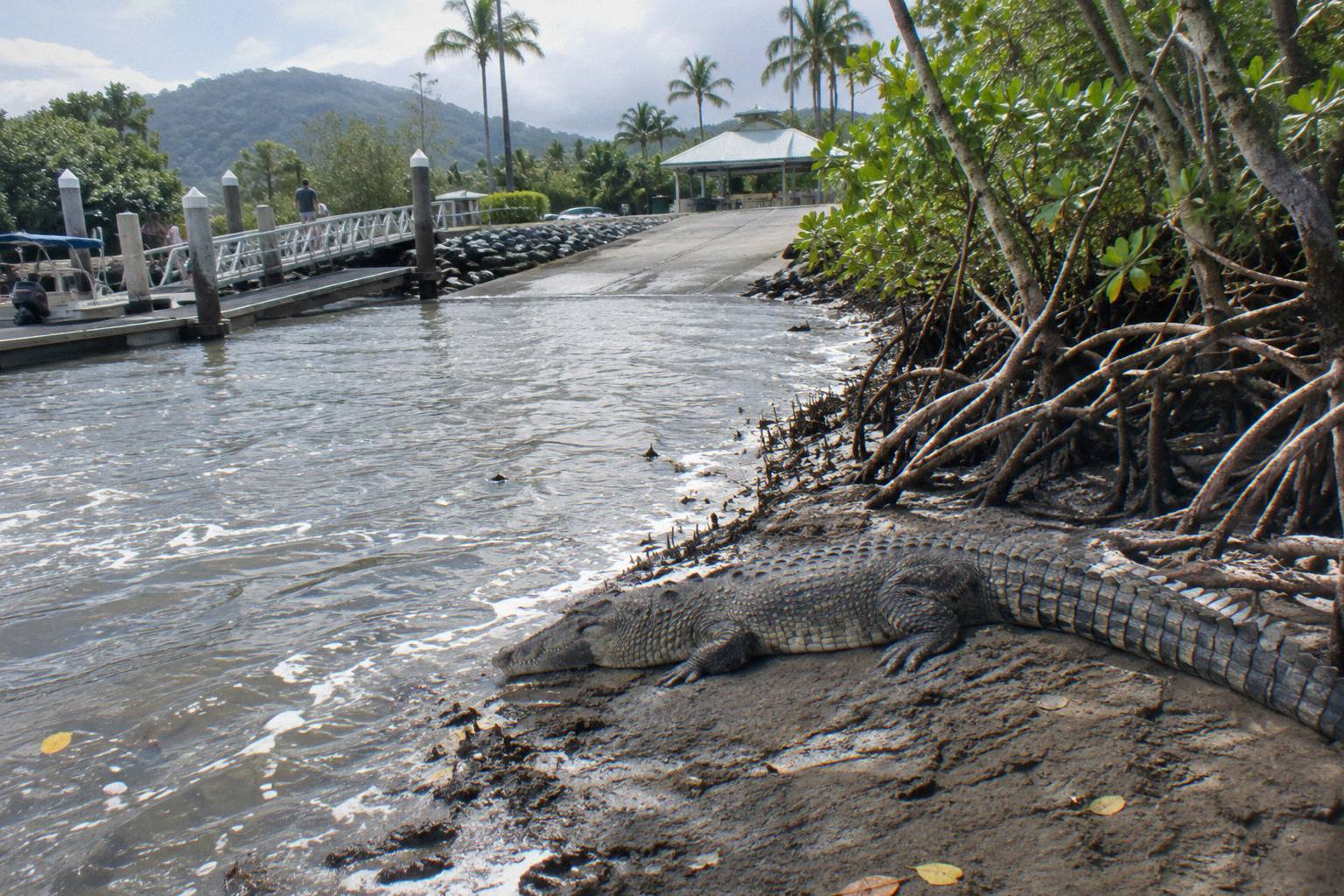
The biology behind the rules is worth knowing because it explains why the advice is so unbending. Males mature at about 17 years and around 3.3 metres, females at about 12 years and around 2.3 metres, and courtship begins in October and November with nesting from December to April. During the breeding season, male crocodiles become very mobile as they look for a mate, so sightings are more prevalent, in the Government's own words. Crocodiles are most active at night, dusk and dawn, and highly mobile during and after high tides and heavy rain. An animal that was not in a stretch of water yesterday can be there today, which is exactly why the "crocodile free" framing does not exist in official advice. Wild lifespan is unknown, with crocodiles expected to live for 50 years or more, so a large resident animal may have outlasted several generations of local guides.
| The line | What it is | What it means in practice |
|---|---|---|
| 5 metres from the water's edge | Safety advice | Stand back from riverbanks and mangrove edges at any time of day |
| 10 metres from a basking crocodile | Legal distance | Remaining closer, disturbing or feeding one can be an offence |
| Boat as a barrier | Boating advice | Arms and legs inside the vessel; avoid kayaks and paddleboards |
One more point that separates Queensland river cruises from the Northern Territory "jumping crocodile" format people sometimes picture: in Queensland, deliberately disturbing or feeding a crocodile is an offence, so a Daintree cruise is a spotting trip, never a feeding show. The safety picture on the boats themselves covers how the vessels and the wildlife interact, and the saltwater crocodiles of the Daintree River goes deeper on the animal.
Why The Wet Season Changes The Conversation
From January to March, Port Douglas records 395 to 429 millimetres of rain per month, against just 23 to 32 millimetres in the driest stretch of July to September. Heavy rain makes crocodiles highly mobile, in the Government's wording, so a river that seemed quiet one week can carry new animals the next, and the swimming question becomes even less open to negotiation.
The numbers come from the Bureau of Meteorology's Port Douglas climate record, 52 years of temperatures and 124 years of rainfall, and they shape the cruise season as much as the swimming one. Operators see it too: Lady Douglas says crocodiles are normally seen on over 90 percent of trips, especially in the dry season from May to November, and Bruce Belcher's says crocodiles are spotted on 98 percent of trips in the cooler months of June to September and about 50/50 in the warmer months, which it ties to breeding and the wet season. Solar Whisper says the river warms in the hotter months and crocodiles become harder to see. None of that is a reason to treat the water as safer in any season, and no operator suggests it is.
| Month | Mean max temp | Mean rainfall | Rain days of 1mm or more |
|---|---|---|---|
| January | 30.3 °C | 395.8 mm | 13.8 |
| March | 29.5 °C | 429.4 mm | 14.4 |
| July | 24.6 °C | 26.4 mm | 4.2 |
| September | 26.7 °C | 32.1 mm | 4.4 |
| November | 29.5 °C | 106.1 mm | 7.6 |
If timing a trip around the animals, the best month for a Daintree crocodile cruise unpacks the seasonal pattern, and the wet season operations question deals with what actually happens to the boats when the rain arrives. Daylight is generous year round, which helps tour planning: about 13 hours of daylight in January and about 11.2 hours in the middle of the year.
Where Swimming Does Happen On A Daintree Day
The swims on Daintree day tours happen at Mossman Gorge and at upstream waterfall locations, freshwater sites reached by road, never in the river the boats use. The Port Douglas Daintree Half Day Tour includes a Mossman Gorge walk and swim alongside its one-hour river cruise, and the full-day Daintree Experience lists a waterfall swim as a stop. No cruise on the Daintree River includes swimming.
The half-day tour is the practical answer for anyone who wants both experiences in one afternoon. Daintree Discovery Tours runs it from 12:50pm to 5:30pm, about 5 hours in total, picking up at Port Douglas accommodation including resorts, apartments, holiday homes and caravan parks. The booking page lists the gorge walk and swim, the river cruise with a beer, wine or soft drink and a small snack, chilled water, raincoats, umbrellas and insect repellent, and drop-off back at your door. It is rated 4.5 from 117 reviews, from US$121 per person, with free cancellation up to 24 hours before start, and it is not suitable for children under 3. You can check availability for the half-day Daintree tour with river cruise alongside the Half-Day Tour, Snack On Cruise link to its live booking page.
The full-day Daintree Experience goes further: 8 hours from US$165 per person, with pickup from any Port Douglas or Mossman accommodation, a waterfall walk and swim, a secret trail, a gourmet lunch at a rainforest restaurant, tropical fruit tasting, a guided walk and a search for giant estuarine crocodiles on the Daintree River. Its waterfall stop is a listed part of that itinerary, and it is not suitable for children under 10 or people with mobility impairments. Deciding between the two formats comes down to time and appetite, and the day tours that include a crocodile cruise compare them side by side.
The key mental split is simple: freshwater gorge and waterfall swimming on one side of the day, crocodile river cruising on the other, and never the two mixed. Operators are consistent about it because the alternative is not a grey area, it is the single most serious mistake a visitor to this coast can make. Families juggling both should also glance at the ages, seats and safety guide for kids, since the minimum-age rules differ sharply between the boats and the tours.
Common Mistakes People Make Around Daintree Waterways
The recurring errors are standing too close to the water's edge at cruise jetties and riverbanks, assuming a calm stretch of river is empty of crocodiles, treating daytime as a safe window when the animals are simply less visible then, and stepping outside the region's rules because a spot looks like a swimming hole from back home. Each one is common, and each one is corrected by a habit rather than a skill.
Stand back from the edge. The 5 metre advice exists because crocodiles ambush from still water, and a mangrove bank at midday looks identical to a mangrove bank with a crocodile under it. Keep to the walkways at the departure points, board when the crew calls you, and let the boat do the approaching.
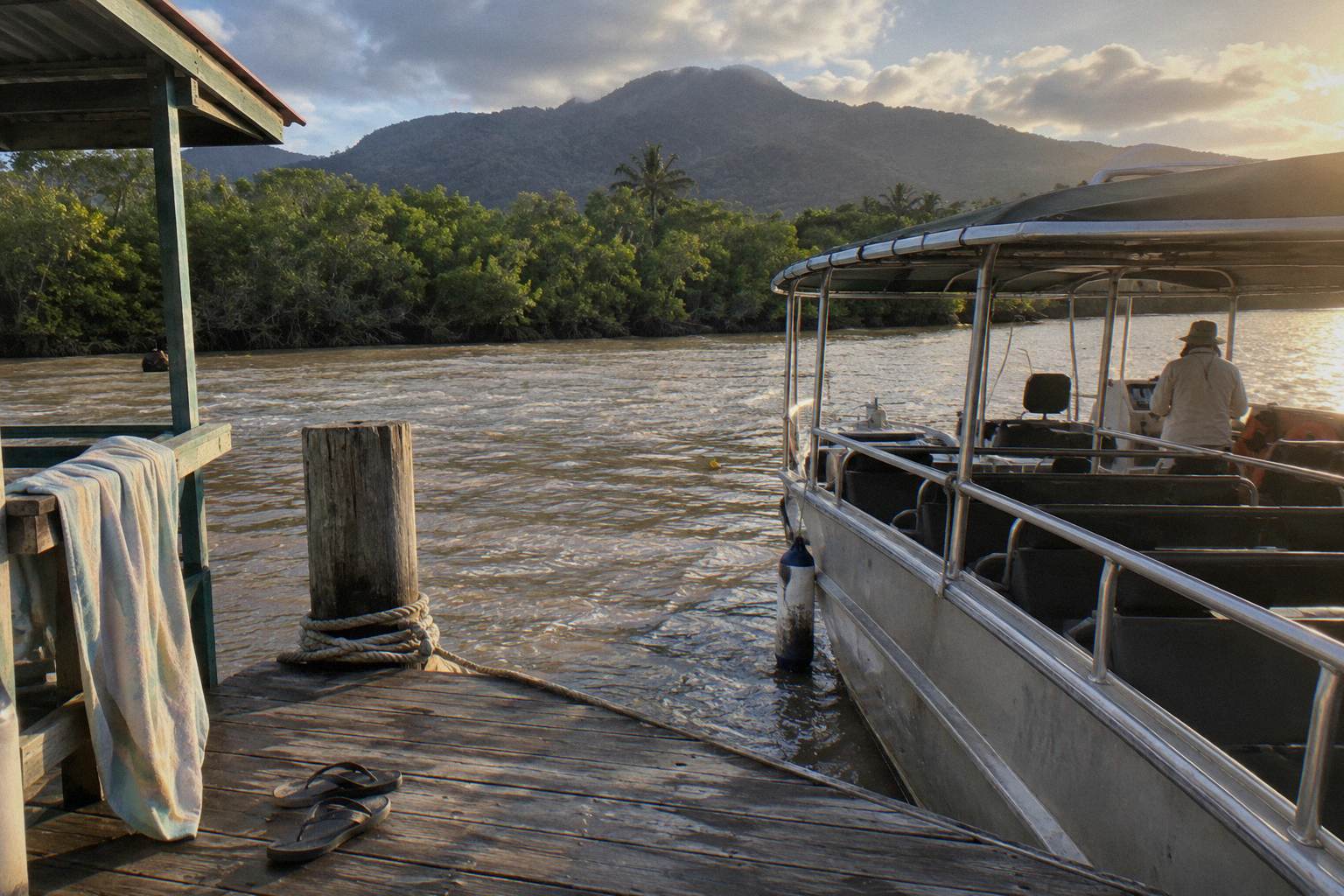
Trust the format. Arms and legs inside the boat is not caution for nervous passengers, it is the official boating guidance for crocodile waters, and it is why the cruise experience can be relaxed while the water next to it never is. Kayaks and paddleboards are singled out in the same advice as craft to avoid, which tells you how the authorities rank proximity.
Read the stop, not the scenery. A freshwater gorge with clear rushing water is a different proposition from a tidal brown river, and the day tours are built around that difference. When a tour lists a swim, the swim belongs to that stop and its conditions; when it lists a river cruise, the boat is the whole experience. Keeping those categories separate is the entire safety lesson of the Daintree in one sentence, and it is why Port Douglas Crocodile Cruises exists as a resource at all: the boats are the way to meet this river.
Common Questions About Swimming And The Daintree River
Is It Safe To Swim In The Daintree River Where Croc Cruises Run?
No. The Queensland Government says no waterway within crocodile range can be considered crocodile free, and the cruise stretches are tidal estuarine crocodile habitat. The cruises are boat-based spotting trips and include no swimming.
Can You Swim Anywhere On A Daintree Crocodile Cruise?
No cruise on the Daintree River includes swimming. The boats stay on the water for the whole trip, and the departure jetties at Daintree Village, the south side and the ferry end are boarding areas, not swimming areas.
Where Can You Swim On A Daintree Day Tour?
The Port Douglas Daintree Half Day Tour includes a Mossman Gorge walk and swim, and the full-day Daintree Experience lists a swim beneath a secluded waterfall. Both swims are at separate freshwater stops reached by road, not in the crocodile river.
How Close Can You Legally Get To A Crocodile In Queensland?
It is an offence to remain within 10 metres of a crocodile basking on a sandbar or riverbank, to disturb one by approaching within 10 metres from a boat or vehicle without reasonable excuse, or to feed one. Safety advice separately says to stay more than 5 metres from the water's edge.
Are Crocodiles More Active At Some Times Of Day?
Yes. The Government says crocodiles are most active at night, dusk and dawn, and very mobile during and after high tides and heavy rain. Be Crocwise advice is to be extra cautious at those times.
Do Crocodile Cruises Run At Night On The Daintree?
No night cruise exists among the trips covered here. Every trip runs in daylight, at dawn or around dusk, with the Daintree Boatman sunset cruise the latest-running option at two hours.