
Are There Crocs In Daintree Forest?
Yes, crocodiles live across the Daintree, and the tidal reaches of the Daintree River are where the cruises run. Here is what the Queensland Government and the operators themselves say about where, when and how you see them.
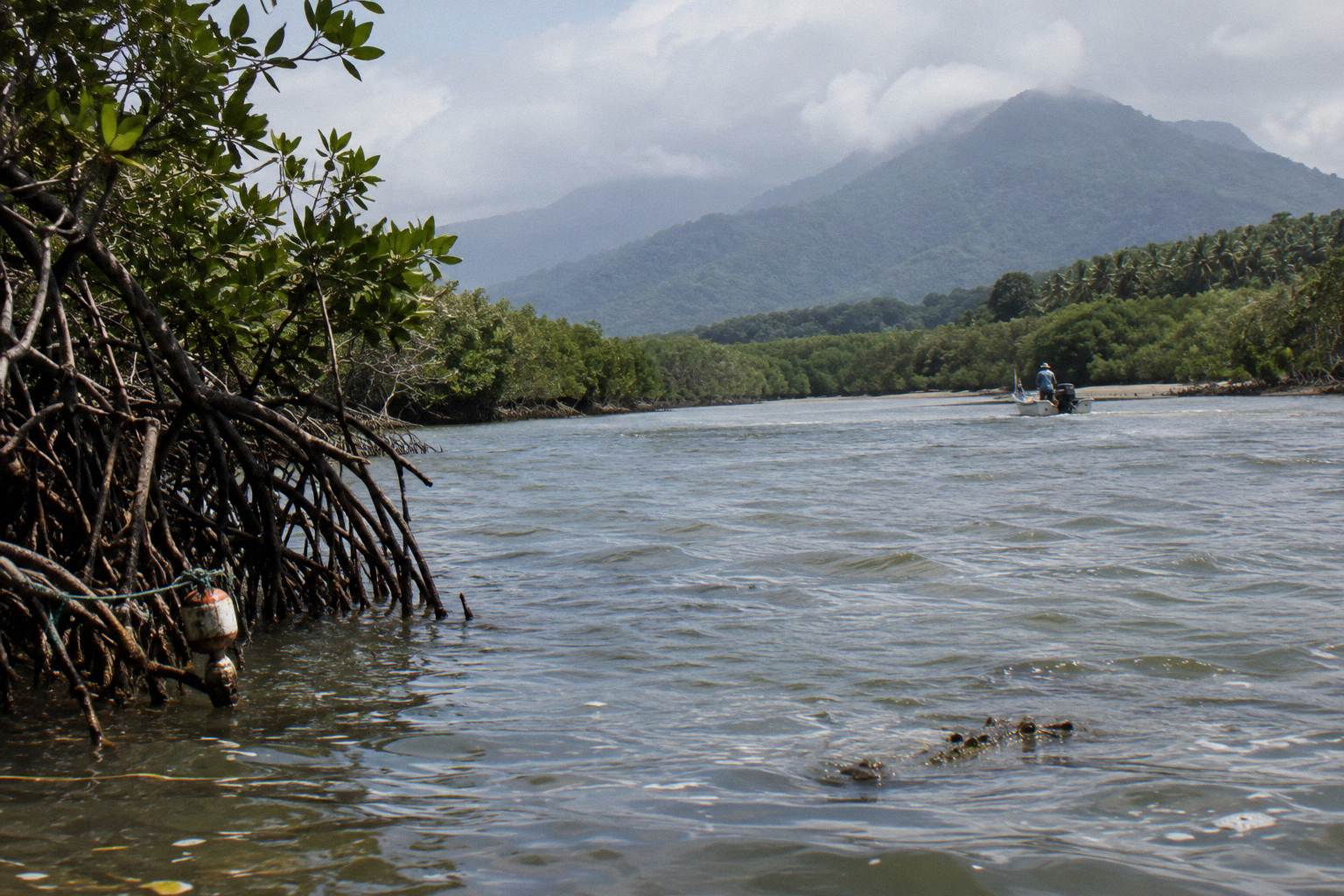
Yes. Estuarine crocodiles live throughout the Daintree's waterways, and the Queensland Government places them between Gladstone and Cape York Peninsula, most commonly in the tidal reaches of rivers. The Daintree River is that water here, and it is where every cruise departs. A rainforest walk and a crocodile cruise share one destination but visit two different habitats.
The question hides a geography lesson. What most visitors call "the Daintree" is the Wet Tropics of Queensland, inscribed on the UNESCO World Heritage List in 1988, about 895,000 hectares holding some of the oldest continuously surviving tropical rainforests on Earth. Within it, the Daintree River winds from rainforest ranges down to a wide tidal estuary at its mouth near the ferry. The crocodiles follow that gradient. Upstream the water is narrower and calmer, overhung with trees; downstream it opens into mangrove-lined tidal flats, which is exactly the habitat the Government describes as where crocodiles are most commonly seen.
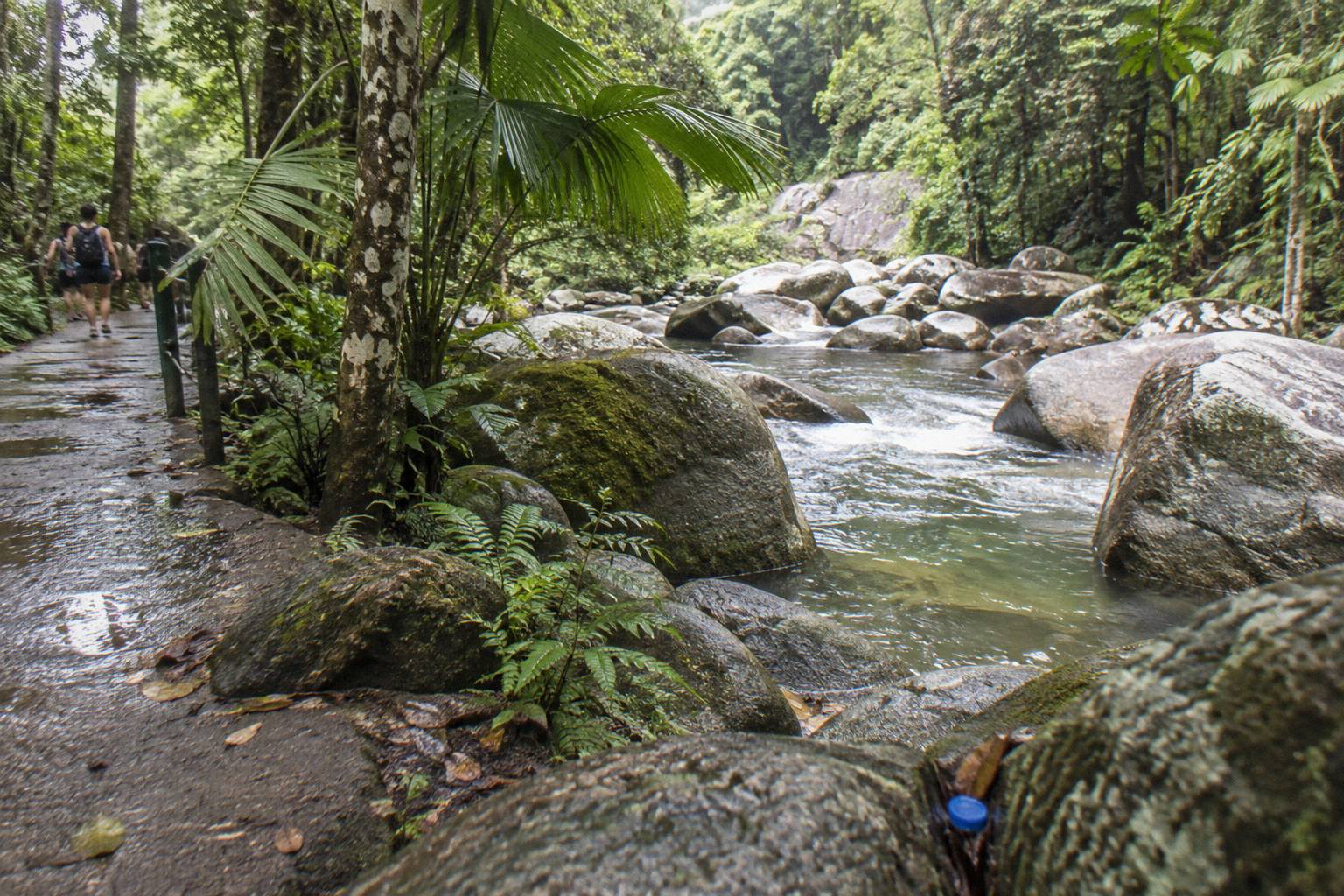
None of the covered cruise routes ask you to walk into the forest to find one. The boats work the river, because that is where the animals hunt, bask and travel. Walking in the rainforest, on the other hand, is a different activity entirely, and a crocodile encounter on a walking track is not something any operator here promises or sells. The two worlds meet in only one kind of day out: a combined tour that walks the rainforest and then boards a boat on the crocodile water.
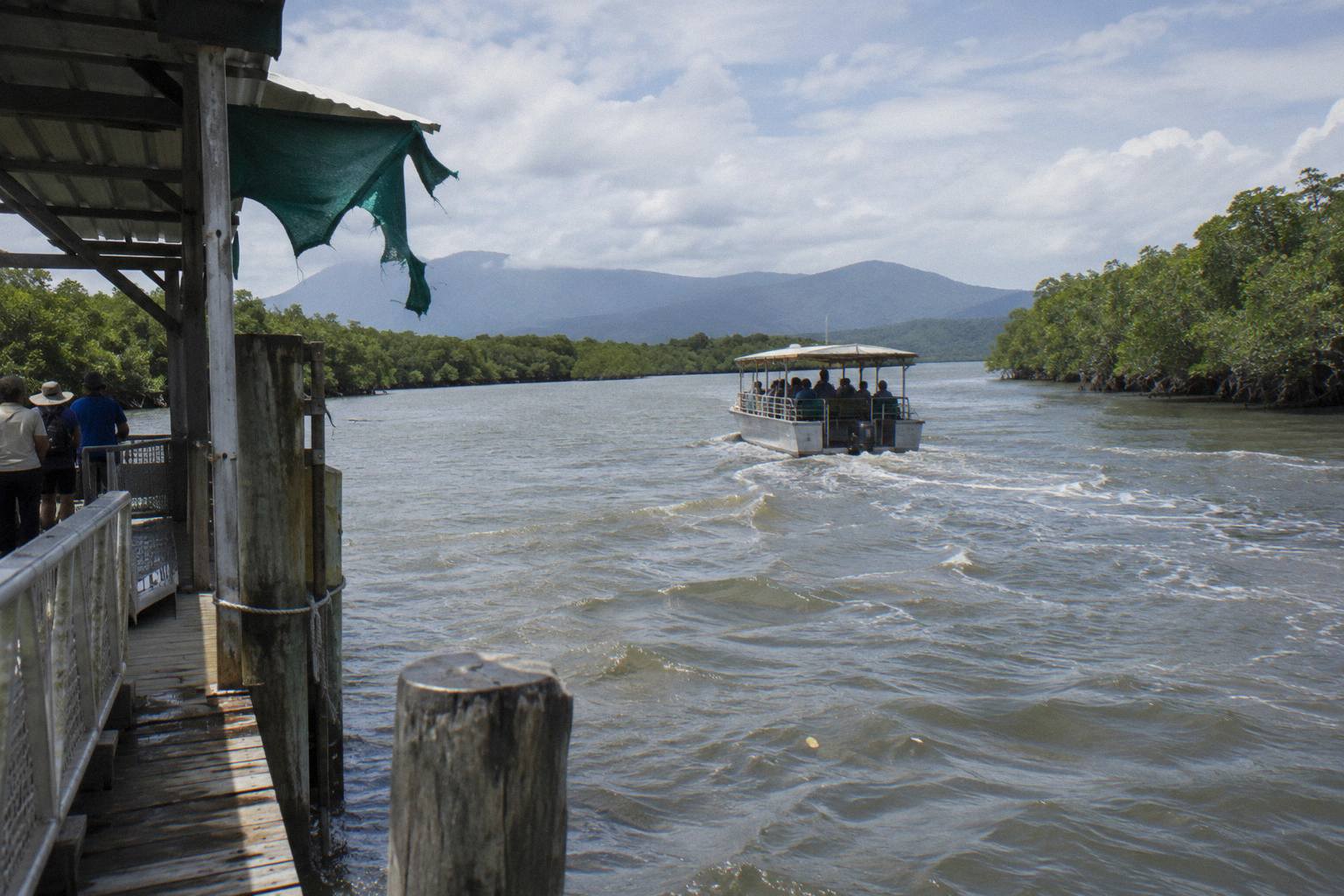
For a reader deciding whether a cruise is worth the drive, three trips cover the spread. The full-day tour walks the forest and cruises the river in one booking; Lady Douglas cruises from Port Douglas itself; the Cruise Centre runs the cheapest one-hour river trip.
Where Crocodiles Actually Live In The Daintree
Crocodiles in the Daintree live in and along the water: the tidal river reaches, the mangrove banks, the inlet mouths and the estuary. Queensland Government guidance is blunt that no waterway within the crocodile's natural range can be considered crocodile free, so creeks, swimming holes and riverbanks anywhere in the region deserve the same caution.
The Government's estuarine crocodile page states the range plainly: between Gladstone and Cape York Peninsula, and throughout the Gulf of Carpentaria, with sightings most common in tidal river reaches. The Daintree River's lower section is a textbook version of that habitat. Crocodile Express describes the Upper Daintree near the village as narrower and calmer with overhanging trees, and the Lower Daintree near the ferry as a wide tidal estuary with mangroves. Both stretches hold crocodiles; the cruises run on both.
The practical split for a visitor looks like this:
| Where | Crocodile presence | What runs there |
|---|---|---|
| Daintree River, village end | Narrower, calmer water under overhanging trees | Crocodile Express Cruise 1, Daintree Boatman, Cruise Centre nearby |
| Daintree River, ferry end | Wide tidal estuary with mangrove banks | Crocodile Express Cruise 2, Solar Whisper, Bruce Belcher's nearby |
| Dickson Inlet, Port Douglas | Mangrove inlet, a separate waterway from the Daintree River | Lady Douglas |
| Rainforest walking tracks | Crocodiles range widely, no operator here runs walks to see them | Walking appears only as a stop inside the full-day tour |
Lady Douglas deserves its own sentence: it departs the Crystalbrook Superyacht Marina at 44 Wharf Street and cruises Dickson Inlet, a mangrove inlet at Port Douglas that is a different waterway from the Daintree River altogether. It is the only scheduled crocodile cruise covered here that leaves from Port Douglas itself, cruising since 1989 with the operator describing a calm-water route through several kilometres of mangrove channels and substantial time spent searching for wild estuarine crocodiles. It rates 4.6 from 571 reviews, from US$32 per person, with free cancellation up to 24 hours before start.
The Government also notes that crocodiles are highly mobile, especially after heavy rain and floods, which is why a creek well away from the river is never automatically a safe one. For more on the animals themselves, the guide to the Daintree's estuarine crocodiles goes deeper, and whether crocodiles appear around Port Douglas covers the town end of the region.
One Booking That Walks The Forest And Cruises The River
The Daintree Experience Full Day is the one covered trip that puts rainforest walking and a crocodile search in the same itinerary: eight hours from US$165 per person, with pickup from any accommodation in Port Douglas or Mossman. It includes a swim beneath a waterfall, a secret trail, a guided walk and a search for giant estuarine crocodiles on the Daintree River.
That last line matters for this question. The booking page lists the river crocodile search as one element of a day built around the rainforest: a gourmet lunch at a rainforest restaurant, a tropical fruit tasting, a chance to see rare rainforest wildlife, and the waterfall walk and swim. Walking in the forest is covered here only as stops inside this tour, which is the one place the two habitats genuinely meet on a single ticket. It carries free cancellation up to 24 hours before start, and the booking page marks it not suitable for children under 10 or people with mobility impairments.
Is the combined day worth it against a standalone one-hour cruise? That depends on how much Daintree you want. The river-only trips cost from US$24 to US$32 and deliver the crocodile water in sixty to ninety minutes. The full-day tour costs US$165 and delivers the river plus the forest, the waterfall and lunch. A reader asking whether there are crocs in the forest is usually weighing exactly that trade.
Wondering whether the boat part delivers? The operator's own framing is a search, not a promise, and the wider odds question is covered in how likely a Daintree crocodile sighting really is, where each operator's stated rate sits side by side.
What The Estuarine Crocodile Is, In Numbers
An estuarine crocodile grows to over 4 metres, the Queensland Government says, with the average male 3 to 4 metres and 200 to 300 kilograms; females rarely exceed 3.5 metres and 150 kilograms. Males mature at about 17 years and 3.3 metres, females at about 12 years and 2.3 metres, and wild animals are expected to live 50 years or more.
Those figures come from the Government's species pages, and they explain why the Daintree's crocodiles are so territorial and so visible from a boat. A big male patrols a long stretch of river; nesting females hold quieter banks. Courtship begins in October and November, and nesting runs December to April, with 40 to 70 eggs incubating about 90 days. The Government adds the detail that matters most to a visitor timing a trip: during the breeding season, male crocodiles become very mobile as they look for a mate, so sightings are more prevalent.
Note what those sighting numbers are: each operator's own claim about its own trips, never a guarantee, and never a figure that transfers to the river as a whole. Bruce Belcher's and Solar Whisper both offer a complimentary return cruise if no crocodile is seen, and both say outright that a sighting can never be fully guaranteed. Lady Douglas frames its number against the dry season. Daintree Boatman says crocs and snakes are best between May and October and much more difficult outside that window. Each statement stands alone.
Which Cruise Puts You On The Crocodile Water
The Daintree River trips run from Daintree Village and the south side of the river: the Cruise Centre from US$24, Crocodile Express from US$27 for a two-route pass, Bruce Belcher's from US$30 on a private jetty. From Port Douglas itself, Lady Douglas cruises Dickson Inlet from US$32, and a five-hour half-day tour pairs Mossman Gorge with a river cruise from US$121.
All five river operators sit on the south side or at the village, and none of their cruises crosses the Daintree Ferry. The Daintree River Cruise Centre boards at 2914 Mossman-Daintree Road just before the village and tells guests not to cross the ferry; its own page lists daily departures from 9.30am to 3.30pm, each at least an hour and extended to 1.5 hours when the schedule permits, with morning or afternoon tea included and a 4.6 rating from 558 reviews. Bruce Belcher's has run from its own jetty at 2856 Mossman-Daintree Road since 1987, cruising 8:30am to 3pm, open March to January and closed all February plus Christmas Day and New Year's Day; it rates 4.6 from 154 reviews, includes complimentary Daintree tea or coffee, and requires non-slip shoes for a 200 metre uncovered walk to the boats.
| Trip | Departs from | Duration | From (US$) | Rating |
|---|---|---|---|---|
| Daintree River Cruise Centre | South side, 2914 Mossman-Daintree Rd | 1 hour | US$24 | 4.6 from 558 reviews |
| Crocodile Express | Village and ferry gateway | 1 hour per route | US$27 | 4.6 from 477 reviews |
| Bruce Belcher's | Private jetty, Lower Daintree | 1 hour | US$30 | 4.6 from 154 reviews |
| Lady Douglas | Crystalbrook Marina, Port Douglas | 1.5 hours | US$32 | 4.6 from 571 reviews |
| Half-day tour with cruise | Hotel pickup, Port Douglas | 5 hours | US$121 | 4.5 from 117 reviews |
| Daintree Experience Full Day | Hotel pickup, Port Douglas or Mossman | 8 hours | US$165 | Rating on the booking page |
Crocodile Express is the format outlier: one ticket covers two one-hour cruises, Cruise 1 from Daintree Village at 5 Stewart Street and Cruise 2 from a kiosk about 300 metres before the ferry crossing, with the pass valid 14 days from first activation and daily cruises from 8.30am to 3.30pm on both routes, every day except 25 December. It is not suitable for wheelchair users, as the booking page marks. The Cruise Centre carries the same mark, though its operator says the Centre itself is wheelchair accessible and only its jetty and boats may not suit those needing assistance, so call ahead.
If a river cruise versus a scenic boat ride is the real decision, the comparison of croc-spotting and scenic river cruises breaks down the difference, and the Daintree cruise operators compared lines up every departure point on one map. To sample the cheapest river option:
Best Months And Times Of Day
The dry season, roughly May to November, is when operators say crocodile sightings peak, and the wet months of January to March each drop 395 to 429 mm of rain on Port Douglas. Crocodiles are most active at night, dusk and dawn, so morning and late-afternoon boats sit closest to the animals' active window while every covered trip still runs in daylight.
The Bureau of Meteorology's Port Douglas station, with 52 years of temperature records and 124 years of rainfall, gives the shape of the year. July is the driest month at 26.4 mm over about four rain days; August 23.3 mm; September 32.1 mm. At the other end, February averages 422 mm across 14.2 rain days and March 429.4 mm across 14.4. Daytime means hover between 24.6 and 30.3 degrees all year, so the crocodile question is about water and visibility, not cold. The full monthly picture sits in the Bureau's Port Douglas climate averages.
| Month | Mean max | Mean rainfall mm | Rain days 1mm+ | Sunrise about | Sunset about |
|---|---|---|---|---|---|
| May | 26.7 | 72.8 | 8.0 | 6:34am | 5:56pm |
| July | 24.6 | 26.4 | 4.2 | 6:47am | 6:02pm |
| September | 26.7 | 32.1 | 4.4 | 6:15am | 6:14pm |
| January | 30.3 | 395.8 | 13.8 | 5:58am | 6:57pm |
| March | 29.5 | 429.4 | 14.4 | 6:22am | 6:35pm |
Tide matters as much as month. Bruce Belcher's says low tide can enhance the chances but crocodiles are still seen at high tide; Solar Whisper agrees that low tide is usually better because there are more beaches and less water for crocodiles to hide in, and calls a summer high tide the most difficult time. Neither turns that into a promise, and neither should your planning: treat tide as a lean, not a rule. The deeper mechanics are unpacked in how tides shift crocodile sightings on the Daintree and choosing the month for a Daintree cruise.
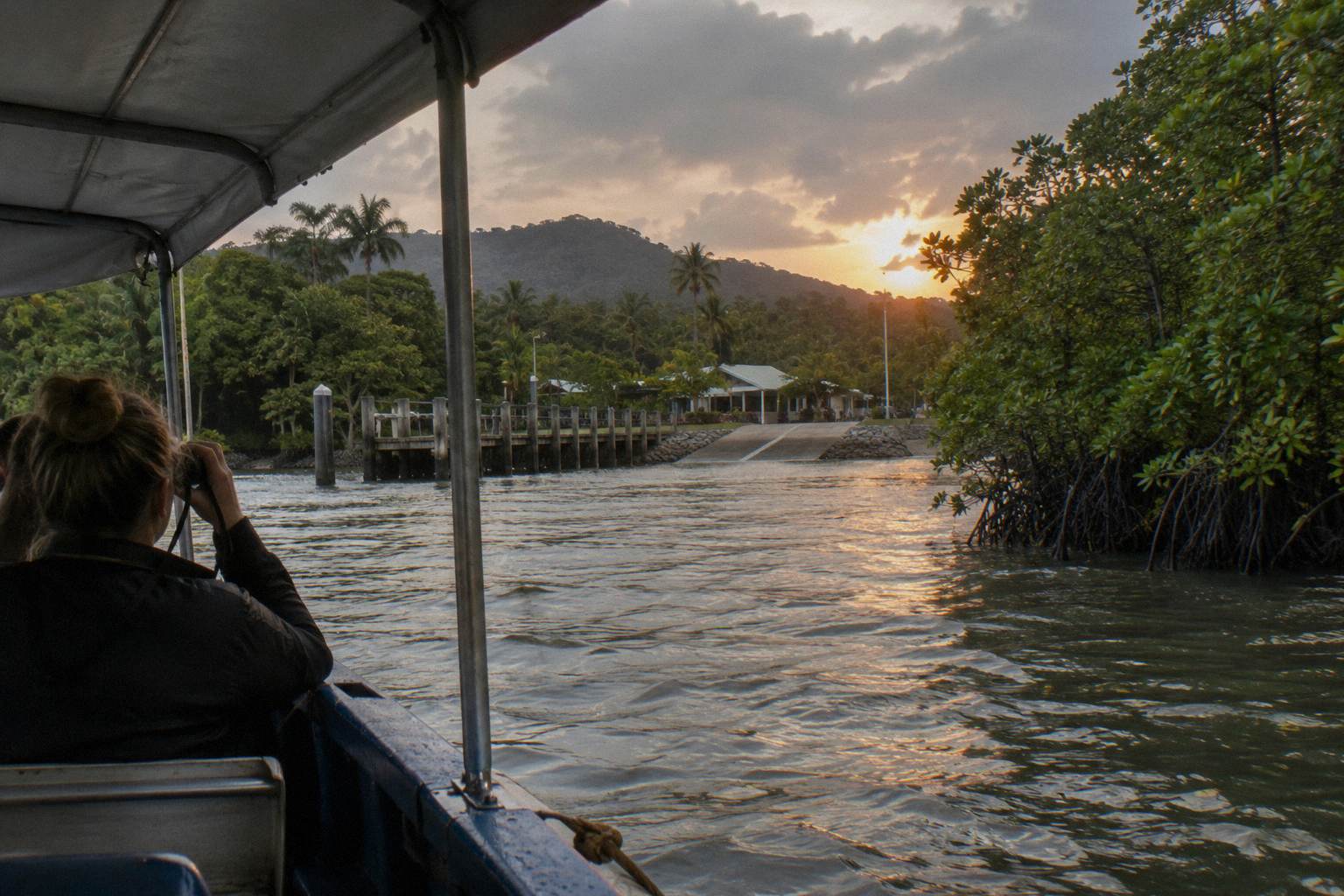
Timing your boat against the sun is free. Sunset at Daintree Village is about 5:54pm in June and 6:57pm in January, and Daintree Boatman's two-hour sunset cruise rides exactly that window, departing 4pm from April to August and 4.30pm from September to January, with a dawn sibling from 7am or 6.30am. Crocodiles are most active at dusk and dawn, the Government says, so those departures sit inside the animals' rhythm. No night cruise exists among the trips here; every one runs in daylight or around dusk.
Safety Rules At The Water's Edge
Be Crocwise advice from the Queensland Government is to stay more than 5 metres from the water's edge, be extra cautious at night, dusk and dawn, and assume crocodile interactions can occur at any time of year, because no waterway in the crocodile's natural range can be considered crocodile free. On the water, keep arms and legs inside the boat and let the boat act as the barrier.
The 5 metre line is advice; the 10 metre line is law. It is an offence in Queensland to remain within 10 metres of a crocodile basking on a sandbar or riverbank, to disturb one by approaching within 10 metres in a boat or vehicle without a reasonable excuse, or to feed one. That last point separates Queensland cruising from the Northern Territory's jumping-crocodile format: deliberately feeding or disturbing a crocodile is an offence, so a Daintree cruise is a spotting trip, not a feeding show, a distinction drawn fully in the jumping crocodile cruise versus Daintree comparison.
None of the above says the forest or the river is safe or unsafe to swim; that verdict is not yours or ours to hand out, and the Government's own phrasing carries the caution. What can be stated is operational: Solar Whisper runs in rain but not in flood, and Bruce Belcher's pulls clear screens down across its boats in heavy rain. The half-day tour's Mossman Gorge swim sits in a freshwater swimming area managed as part of that tour's itinerary, and that is the only swimming any covered trip includes. The broader risk picture is in croc cruise safety on the Daintree.
A word on wildlife beyond crocodiles, because the river delivers it constantly. Operators list sea eagles, kites, ospreys, kingfishers, herons, azure and little kingfishers, great-billed herons, shining flycatchers, tree snakes, water dragons and amethystine pythons; the Cruise Centre says over 280 bird species are recorded in the region. "Operators list" is the right verb, because no operator can tell you what you will see, only what their boats find. The full cast is in the Daintree's birds, snakes and crocodiles, and what else appears on a Daintree cruise besides crocodiles.
Common Mistakes Visitors Make
The most common mistakes are treating the forest walk and the river cruise as interchangeable, expecting a guaranteed crocodile, arriving at the wrong departure point, and assuming the ferry is part of the trip. Every covered river cruise departs the south side or the village and never crosses the ferry, and no operator here guarantees a sighting, though two offer a free return cruise if none appears.
| Mistake | What goes wrong | The fix |
|---|---|---|
| Booking a river cruise and expecting a rainforest walk | The cruise stays on the water the whole time | Take a combined tour that includes both |
| Expecting a guaranteed crocodile | No operator guarantees wildlife | Pick an operator with a free return offer |
| Heading north across the Daintree Ferry first | Cruise jetties sit on the south side and village | Cruise first; the ferry is for Cape Tribulation |
| Arriving at the wrong Stewart Street point | Village ramp, Cruise Centre and Crocodile Express differ | Confirm the boarding address when booking |
| Ignoring tide and season | Warm-month high tides are the hardest water | Prefer dry-season months and low-tide slots |
The ferry mistake deserves emphasis because it eats half a day. The Daintree Ferry runs continuously between 5am and midnight daily, including Christmas Day, with long queues expected in school holidays, but none of the cruise routes crosses it. The ferry question, including whether you need it at all, is settled in whether a Daintree cruise requires the ferry, and the base-camp question in whether Daintree Village is worth staying in for a cruise.
Getting there is simple arithmetic. Solar Whisper's own guidance puts Daintree Village and Lower Daintree about 45 minutes from Port Douglas, about 30 minutes from Mossman and about 1.5 hours from Cairns. Queensland has no daylight saving, so those clocks hold year round. For planning the drive itself, see getting from Port Douglas to the Daintree River; for making a whole day of it, fitting a cruise into a Daintree day.
To close the loop with the original question, and the practical version of it that Port Douglas Crocodile Cruises exists to answer: the crocs are real, the river is where the boats meet them, and three trips below span the range from a one-hour village cruise to a full day that walks the forest too.
Common Questions About Crocs In The Daintree Forest
Are There Crocs In Daintree Forest?
Yes. Estuarine crocodiles live throughout the region's waterways, most commonly in the tidal reaches of rivers such as the Daintree, and the Queensland Government states no waterway in their natural range can be considered crocodile free. The cruises run on the river; rainforest walking appears only as stops inside the full-day tour.
Are Crocodiles Guaranteed On A Daintree Cruise?
No operator guarantees a sighting. Bruce Belcher's says 98 percent of its cooler-month trips spot a crocodile, Solar Whisper claims about 99 percent, and both offer a complimentary return cruise if none is seen. Lady Douglas says crocodiles are normally seen on over 90 percent of its trips, especially May to November.
Do You Walk Through Rainforest To See The Crocodiles?
No. Every covered cruise departs a jetty, marina or boat ramp and stays on the water. The only walking tied to crocodiles here is inside the Daintree Experience Full Day, which includes a guided rainforest walk and a waterfall swim alongside its Daintree River crocodile search.
Which Month Has The Most Crocodile Sightings?
Operators point to the dry season: Bruce Belcher's names June to September as its strongest months at 98 percent of trips, Lady Douglas says May to November, and Daintree Boatman says crocs and snakes are best between May and October. January to March is the wettest stretch, with each of those months averaging 395.8 to 429.4 mm of rain on Port Douglas averages.
Is It Safe To Swim In The Daintree?
No verdict either way appears here. Be Crocwise advice is to stay more than 5 metres from the water's edge and be extra cautious at night, dusk and dawn, because crocodile interactions can occur at any time of year. The only swim on any covered trip is the freshwater Mossman Gorge stop on the half-day and the waterfall on the full-day tour.
Can You See Crocodiles Without Crossing The Daintree Ferry?
Yes, always. Every covered cruise departs the south side of the river or from Daintree Village, and the Cruise Centre specifically tells guests not to cross the ferry. The ferry runs 5am to midnight daily but is only needed for Cape Tribulation, not for any crocodile cruise.